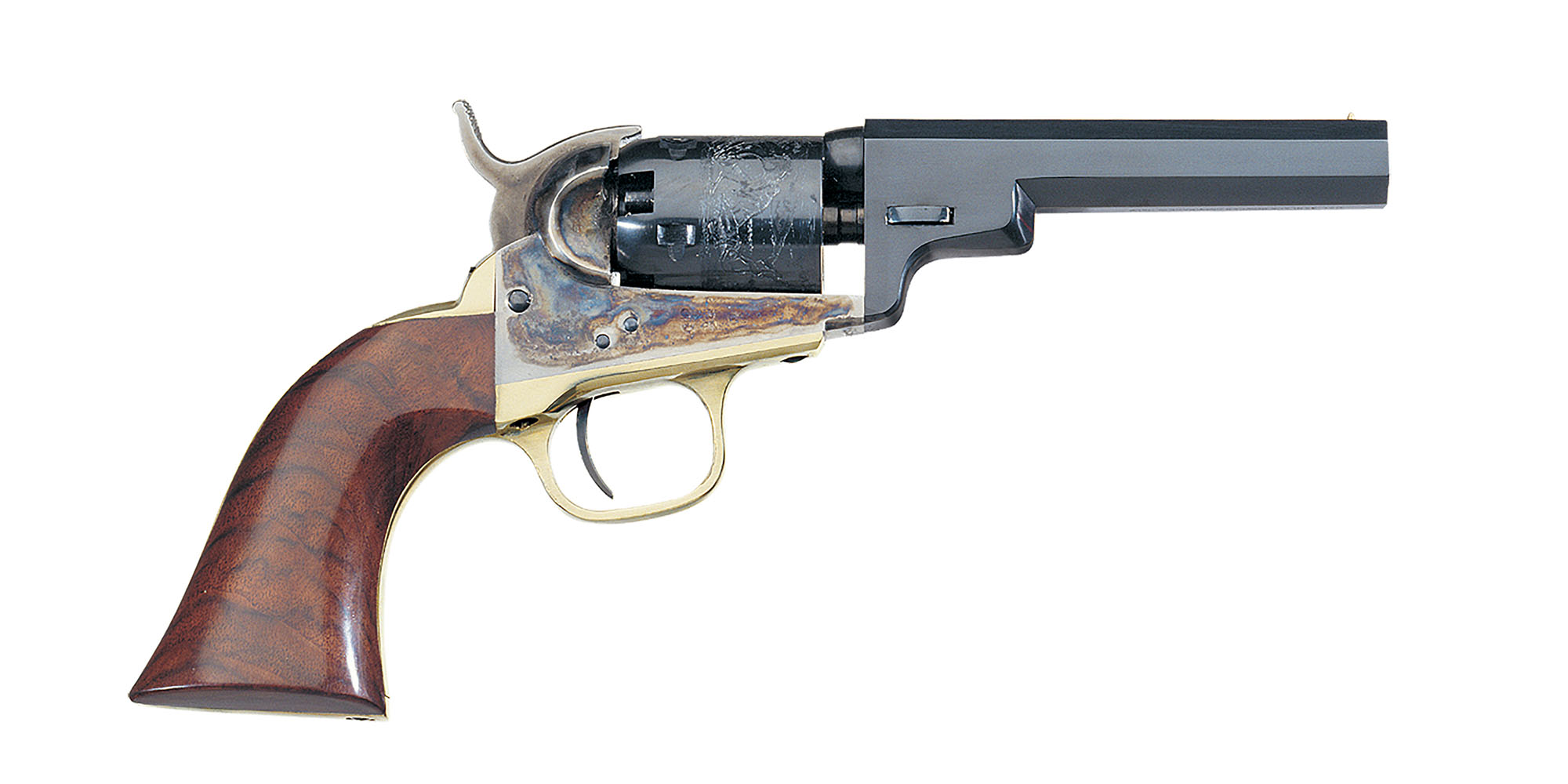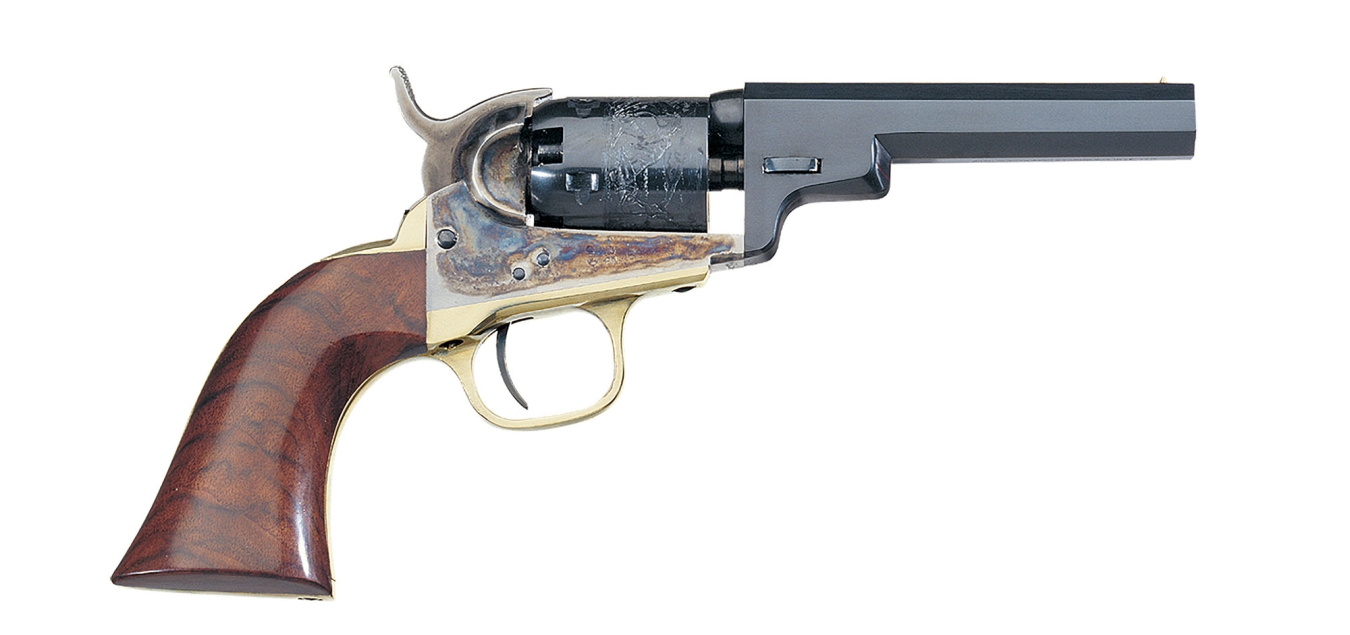
The "Wells Fargo" variant of the 1849 Pocket was a leverless solution designed to satisfy the urgent need for personal defense during the dangerous era of stagecoach travel, securing safe transport of mail, gold and money during the western expansion that exploded after the California Gold Rush.
The Colt 1849 Pocket "Wells Fargo" variant represents a fascinating evolutionary bridge between the original 1848 Baby Dragoon and the more common 1849 Pocket Model. Introduced around 1850, this specific version was produced until approximately 1860, with an estimated production run of roughly little bit more than 6,000 units.
It was created to satisfy a niche market of users who preferred the snag-free, lightweight profile of the earlier leverless 1848 Baby Dragoon, but demanded the updated internal mechanical improvements of the 1849 Pocket line—such as a more reliable trigger and cylinder timing. Mechanically, this variant was a single-action percussion revolver chambered in .31 caliber, typically featuring a five-shot cylinder and a short barrel.
The most defining characteristic of the 1849 Wells Fargo model was the conspicuous absence of a loading lever beneath the barrel. This design choice was entirely intentional; by removing the heavy rammer assembly, the revolver became significantly lighter and much easier to draw from a pocket or waistband without catching on fabric. To reload, the user was required to disassemble the barrel from the frame and use the cylinder arbor as a makeshift ramrod to seat the lead balls.
The model earned its nickname through its widespread use by Wells Fargo agents and stagecoach travelers who needed a compact "hideout" gun. In the cramped quarters of a coach or the high-stakes environment of a gold transport, a quick draw was prioritized over sustained firepower.
Users appreciated the weapon for its sleek ergonomics and the fact that it offered five reliable shots in a package that could be hidden in a vest pocket. While its portability was a major pro, its primary con was the laborious reloading process and the low stopping power of the .31 caliber round. Despite these limitations, it remains a definitive symbol of mid-nineteenth-century personal security.
Variants
- W00 - White finish
- C00 - Charcoal Blue finish
- N00 - Nickel finish
- A00 - Old West antique finish
- G08 - Hand rubbed oil finish on selected wood
- E01 - Standard engraving
- E26 - Hand engraved Monograms
- E27 - Hand engraved single letters
- E28 - Hand engraved gold inlayed letters
The "Wells Fargo" variant of the 1849 Pocket was a leverless solution designed to satisfy the urgent need for personal defense during the dangerous era of stagecoach travel, securing safe transport of mail, gold and money during the western expansion that exploded after the California Gold Rush.