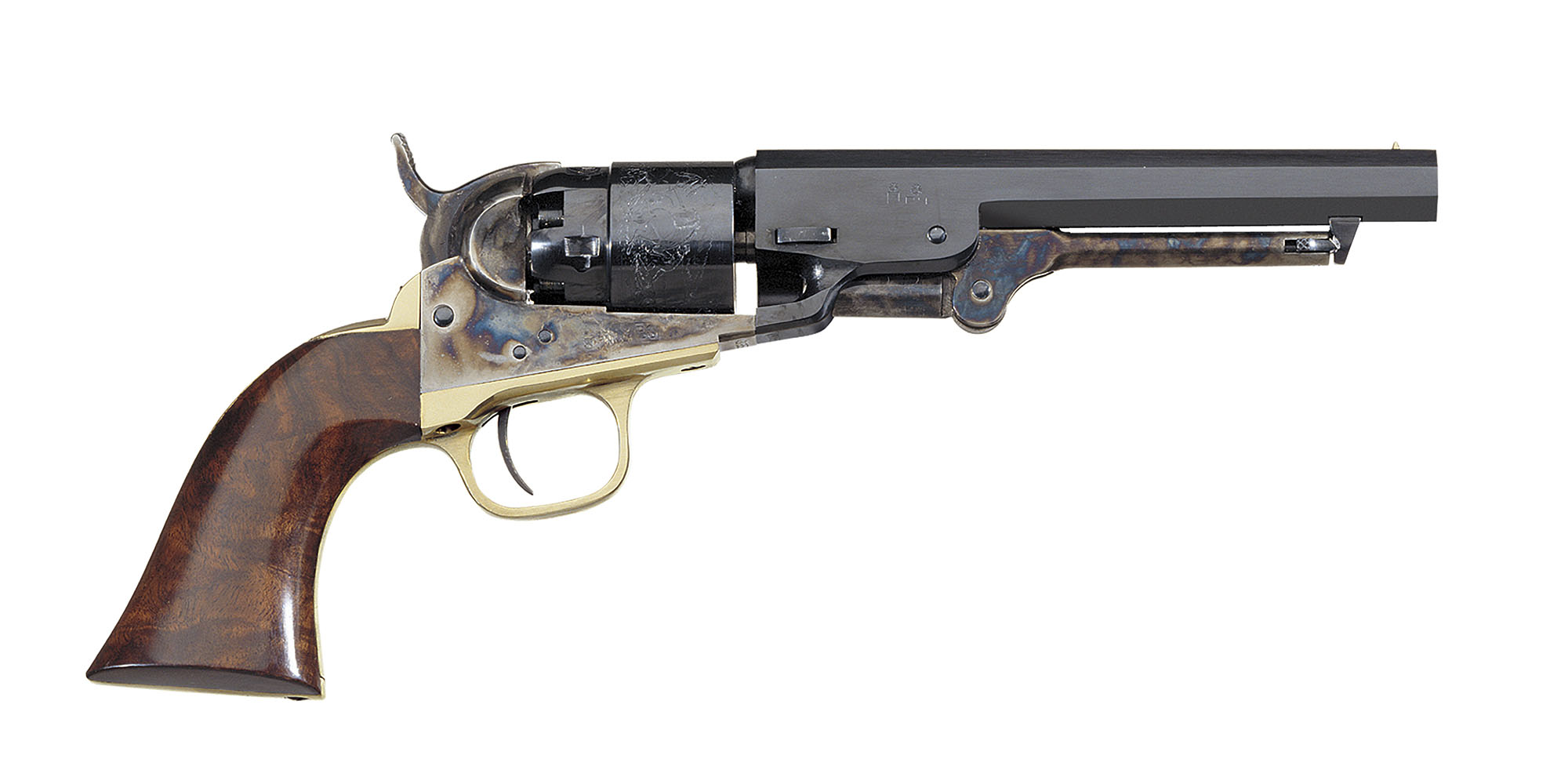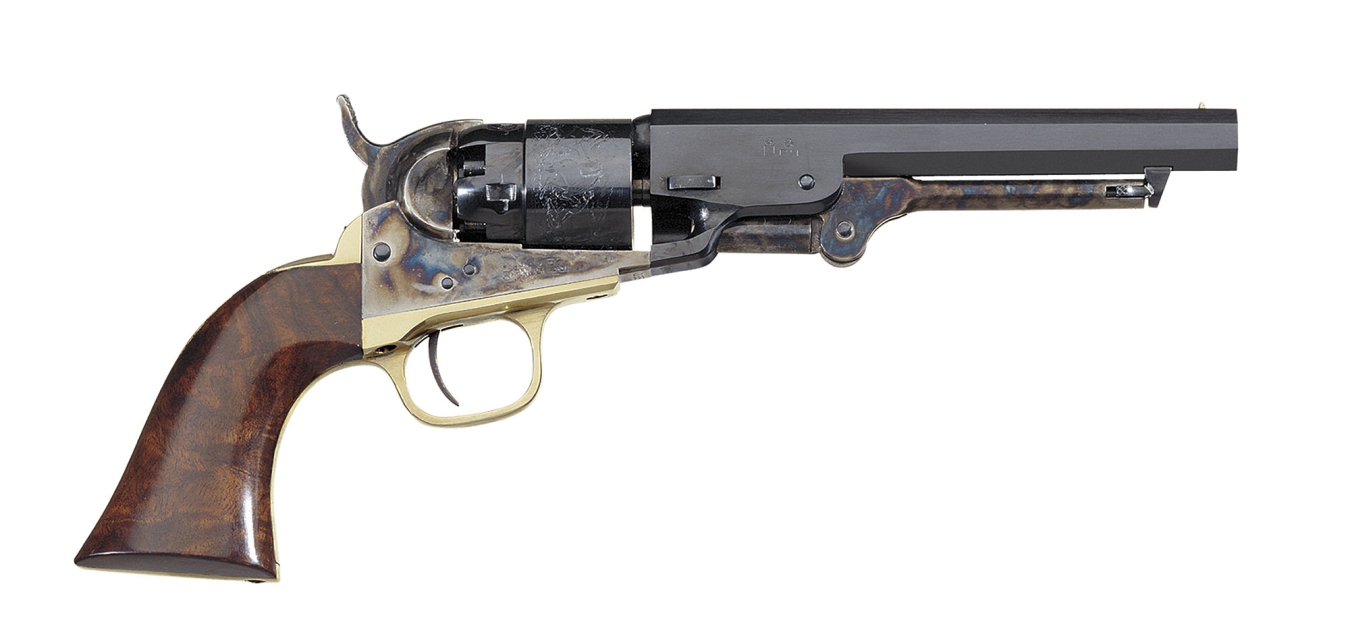
The Colt 1862 Pocket Navy represented the ultimate refinement of compact percussion firearms. It provided civilians and officers with .36 caliber power in a downsized, portable frame during the Civil War era.
The Colt Model 1862 Pocket Navy arrived as a sophisticated solution for those who required a potent sidearm in a compact, concealable package. Introduced alongside its cousin, the 1862 Pocket Police, this model was designed to maximize the firepower available on the smaller "Pocket" frame originally used for .31 caliber revolvers. Production continued until 1873, with approximately 19,000 units manufactured. Its creation was driven by the demand for a lightweight, high-quality weapon that could be carried discreetly by civilians or as a secondary "backup" piece by military officers during the height of the percussion era.
Technically, the 1862 Pocket Navy is a single-action percussion revolver chambered in .36 caliber. It typically features a five-shot cylinder, which was rebated to allow the larger .36 caliber chambers to fit the small frame, and was produced with varying barrel lengths, most commonly 4.5, 5.5, or 6.5 inches.
Visually, it is distinguished by its octagonal barrel and the classic folding-lever loading assembly, differing from the streamlined round barrel and creeping lever found on the Pocket Police. This design maintained the traditional Colt aesthetic while significantly increasing the stopping power of a pocket-sized handgun.
In terms of service, the 1862 Pocket Navy was never a standard-issue military primary weapon, but it saw extensive use during the American Civil War as a private-purchase sidearm. Officers on both sides favored it for its portability during long marches and for the security it offered in camp life. In civil contexts, it became a favorite of stagecoach travelers, gamblers, and undercover lawmen who needed a weapon that could be hidden under a coat but still pack a military-grade punch.
Users greatly appreciated the model for its exquisite balance and the fact that it offered the same caliber as the full-sized Navy models in a much lighter frame. However, its main disadvantage was the reduced capacity of only five shots compared to the six found in larger revolvers, and like all Colt percussion models of the time, the open-top frame lacked the ultimate rigidity of solid-frame competitors. Despite this, its reliability and slim profile ensured its place as the definitive "gentleman’s" revolver of the mid-19th century.
Variants
- W00 - White finish
- C00 - Charcoal Blue finish
- N00 - Nickel finish
- A00 - Old West antique finish
- G08 - Hand rubbed oil finish on selected wood
- E01 - Standard engraving
- E26 - Monograms
- E27 - Single letters
- E28 - Gold inlayed letters
The Colt 1862 Pocket Navy represented the ultimate refinement of compact percussion firearms. It provided civilians and officers with .36 caliber power in a downsized, portable frame during the Civil War era.