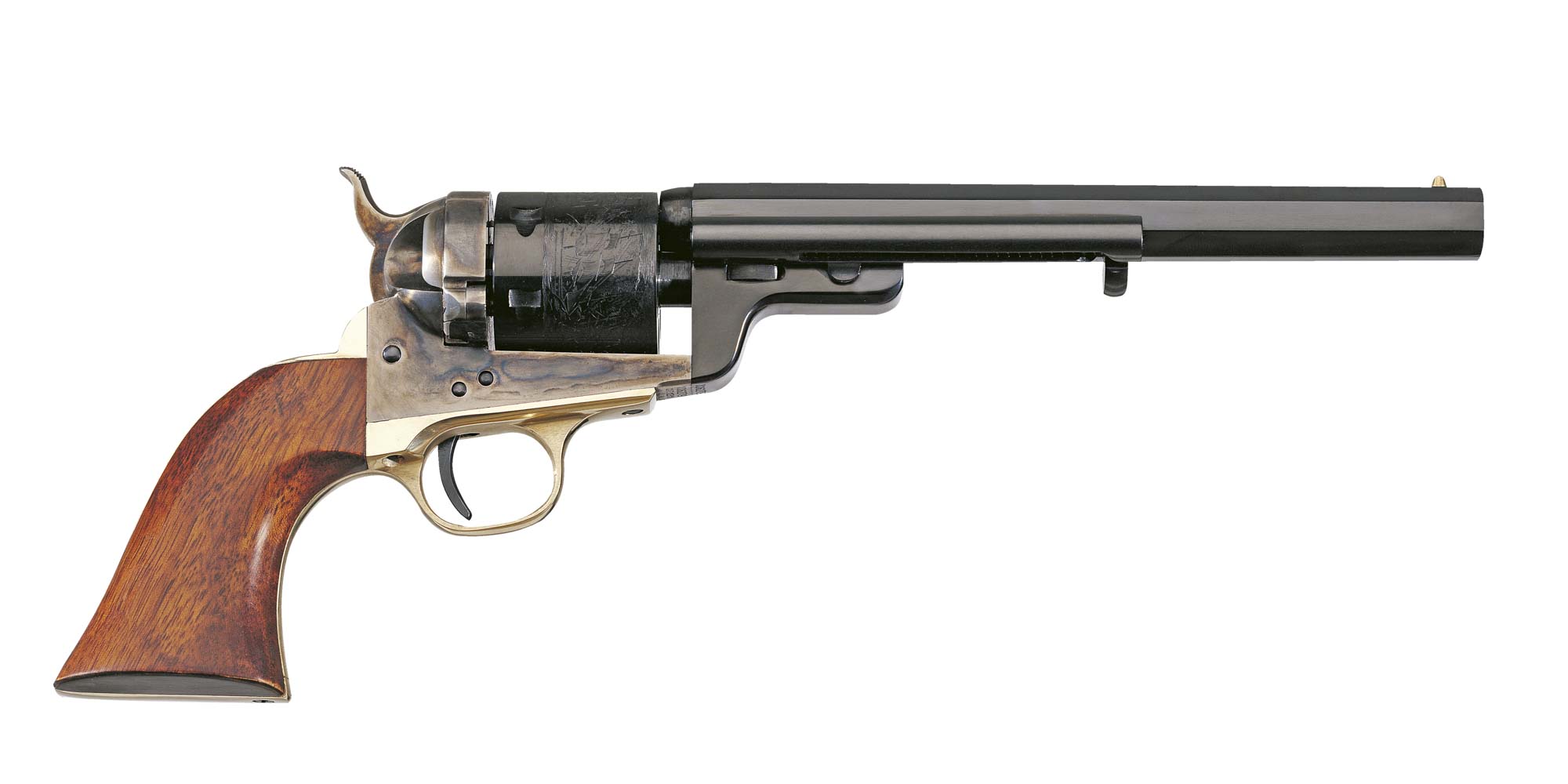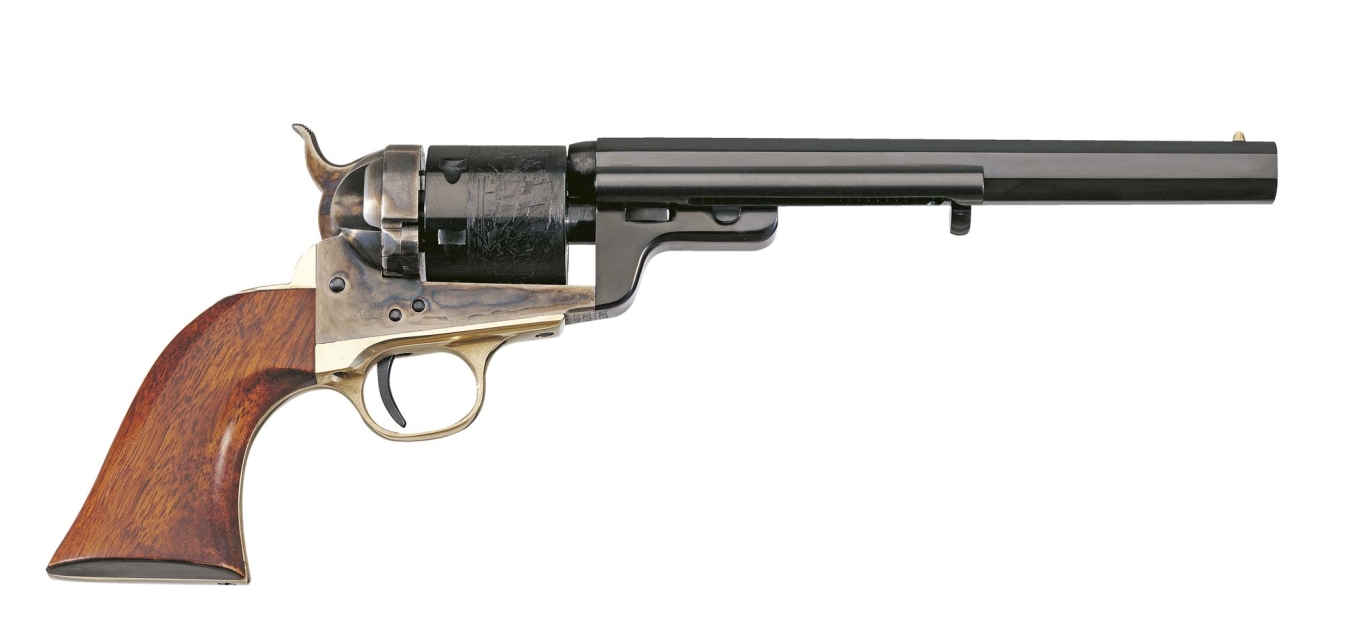
The Colt 1871 Richards-Mason conversion perfected the Colt transition to metallic cartridges. Featuring a refined ejector and hammer-mounted firing pin, this sleek .38-caliber six-shooter offered the legendary 1851 Navy balance with modern reliability.
The Colt 1871 Navy Richards-Mason revolver represents the final, most refined stage of the transition from percussion to metallic cartridges for the legendary 1851 Navy frame. Introduced in the early 1870s, this model was born from the necessity to modernize the Navy’s .36 caliber inventory following the expiration of the Rollin White patent covering the bored-through cylinder in a revolver.
Unlike earlier conversions that relied on existing parts, the Richards-Mason utilized newly manufactured components designed by William Mason, including a hammer-mounted firing pin and a sleek, integral ejector rod. Production of these conversions was relatively focused, running from approximately 1873 to 1878, with roughly 3,800 units produced, making it a scarcer but more mechanically advanced variant than many of its predecessors.
Mechanically, the revolver is a single-action six-shooter and was primarily chambered in .38 Rimfire or .38 Centerfire, obsolete cartridges nowadays that in the Uberti replica have been replaced by the .38 Special. It typically retains the iconic 7.5-inch octagonal barrel of the original Navy model, though some were shortened for easier carry.
While the U.S. Army had largely moved toward the heavier .45 caliber Single Action Army, the Richards-Mason Navy conversion saw significant private and secondary use in military service. Many officers and scouts carried them during the Indian Wars and across the Southwest, valuing the weapon for its lighter weight and the familiarity of the Navy-sized grip.
In civil contexts, the 1871 Richards-Mason was a favorite among anyone still familiar with the balanced feel of the .36-caliber Navy frame. Users deeply appreciated the revolver for its natural pointability and the smooth operation of its modernized ejector system. By moving the firing pin to the hammer and refining the breech, Colt eliminated many of the mechanical hang-ups seen in earlier conversions, but of course, the .38 caliber cartridges of the era lacked the stopping power of the .44 or .45 alternatives.
Variants
- W00 - White finish
- C00 - Charcoal Blue finish
- N00 - Nickel finish
- A00 - Old West antique finish
- G08 - Hand rubbed oil finish on selected wood
- G13 - Polymer Ivory Grip
- G16 - Polymer Pearl Grip
- E02 - Standard hand engraving
- E26 - Hand engraved Monograms
- E27 - Hand engraved single letters
- E28 - Hand engraved gold inlayed letters
- L08 - Standard laser engraving
The Colt 1871 Richards-Mason conversion perfected the Colt transition to metallic cartridges. Featuring a refined ejector and hammer-mounted firing pin, this sleek .38-caliber six-shooter offered the legendary 1851 Navy balance with modern reliability.