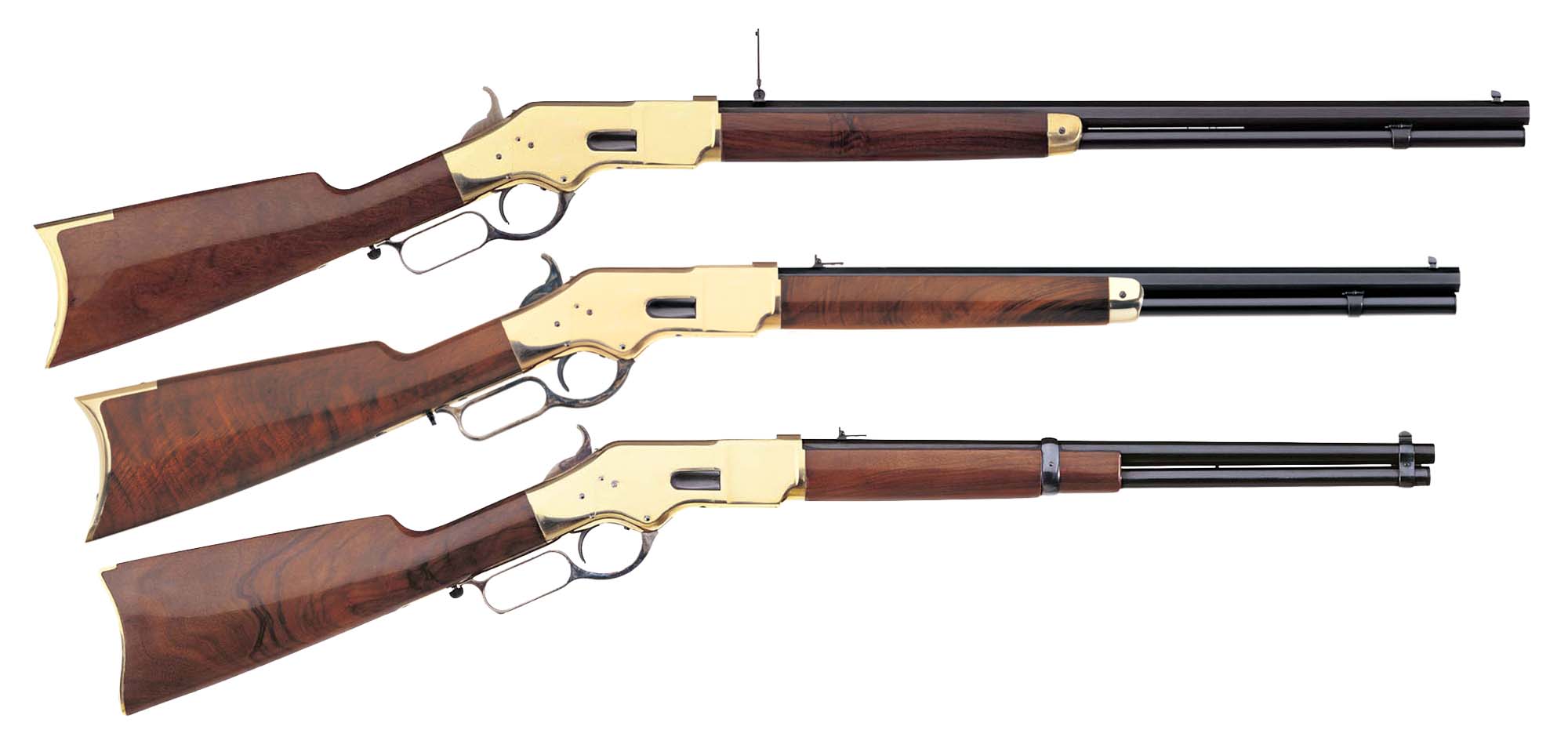
Introduced in 1866, this iconic rifle improved the Henry design by adding a wooden forend and a side-loading gate. Its distinctive brass receiver earned it the famous nickname "Yellow Boy."
The Winchester Model 1866 represents the definitive evolution of the repeating rifle, introduced primarily to rectify the mechanical and ergonomic shortcomings of the earlier Henry rifle. Emerging in 1866 as the first firearm to bear the Winchester name, it remained in production until 1898. During this extensive thirty-two-year run, approximately 170,000 units were manufactured, cementing its status as a cornerstone of American arms history and earning the enduring nickname "Yellow Boy" due to its distinctive brass receiver.
The rifle retained the toggle-link lever action and the .44 Henry rimfire caliber of its predecessor but introduced the revolutionary King’s spring-loaded gate on the side of the receiver, allowing the magazine to be loaded. The standard rifle configuration typically featured a 24-inch octagonal barrel, though carbine variants with 20-inch barrels were also highly popular.
While the U.S. military remained hesitant to adopt repeating rifles as standard issue, the Model 1866 saw significant international use beyond American borders: the Ottoman Empire purchased thousands, famously using them to devastating effect against Russian forces during the Siege of Plevna in 1877.
In North America the model 1866 was a staple of the post-Civil War Westward expansion, serving as a reliable companion for lawmen, settlers, and outlaws alike who required rapid-fire capabilities for self-defense and hunting. The Model 1866 was appreciated for the addition of a wooden forend and for the sealed tube magazine, which prevented dirt and debris to jam the rifle.
The rifle still faced the limitation of being chambered for the relatively low-powered .44 Henry rimfire cartridge, which lacked the necessary stopping power: not anymore a problem in the modern Uberti 1866 rifles and carbines replicas.
Variants
- W02 - White finish
- C02 - Charcoal Blue finish
- AS1 - Carbine saddle ring
- G05 - Deluxe selected walnut stock, buffed finish
- E19 - Standard hand engraving
- E45 - Deluxe hand engraving
- E20 - Mexican Eagle hand engraving
- E21 - Red Cloud hand engraving
- E30 - Solid Silver frame (complete rifle)
- E26 - Hand engraved Monograms
- E27 - Hand engraved single letters
- E28 - Hand engraved gold inlayed letters
- L03 - Standard laser engraving
- L04 - Indian laser engraving with nails
- L11 - "Stag" laser engraving
- L20 - 150th anniversary laser engraving
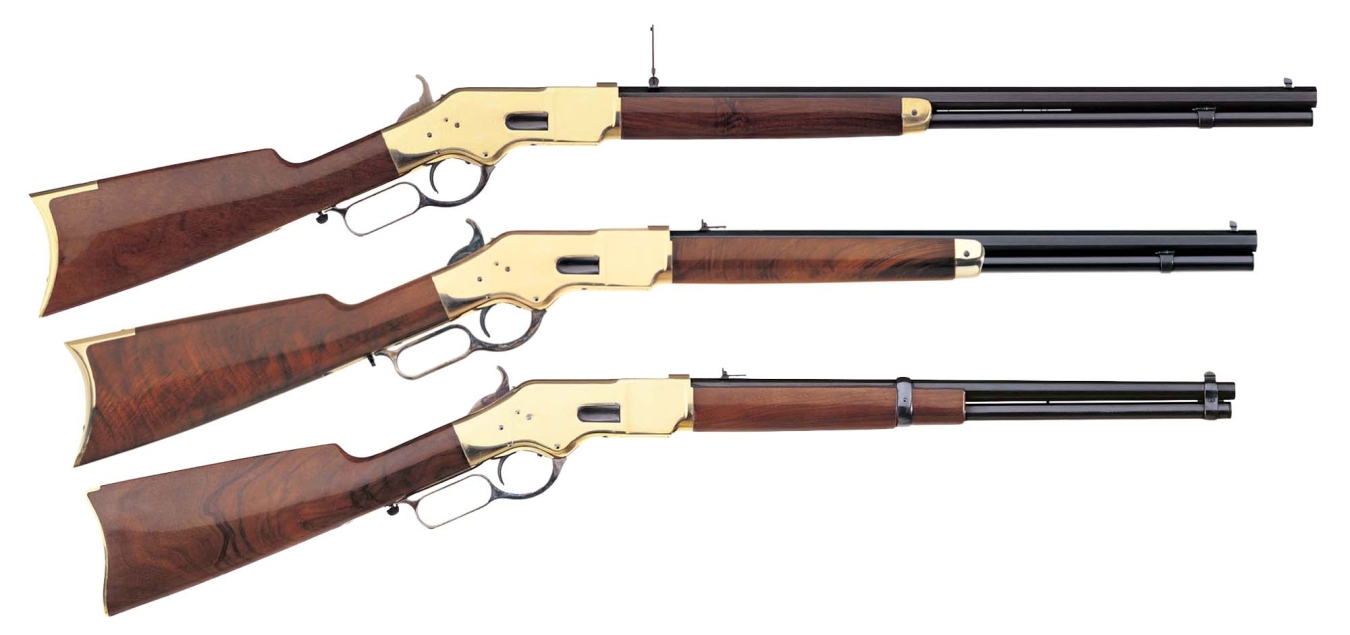
Introduced in 1866, this iconic rifle improved the Henry design by adding a wooden forend and a side-loading gate. Its distinctive brass receiver earned it the famous nickname "Yellow Boy."