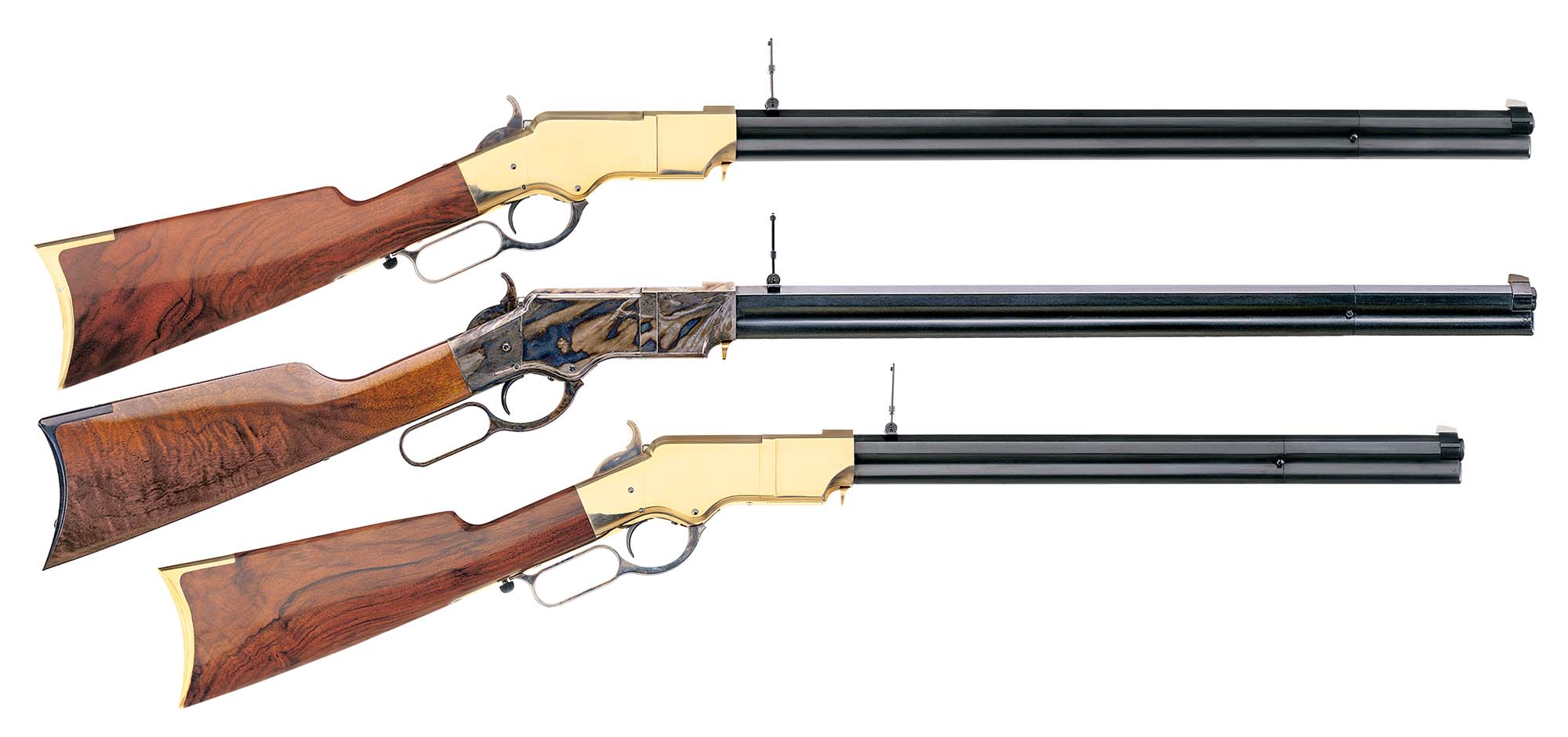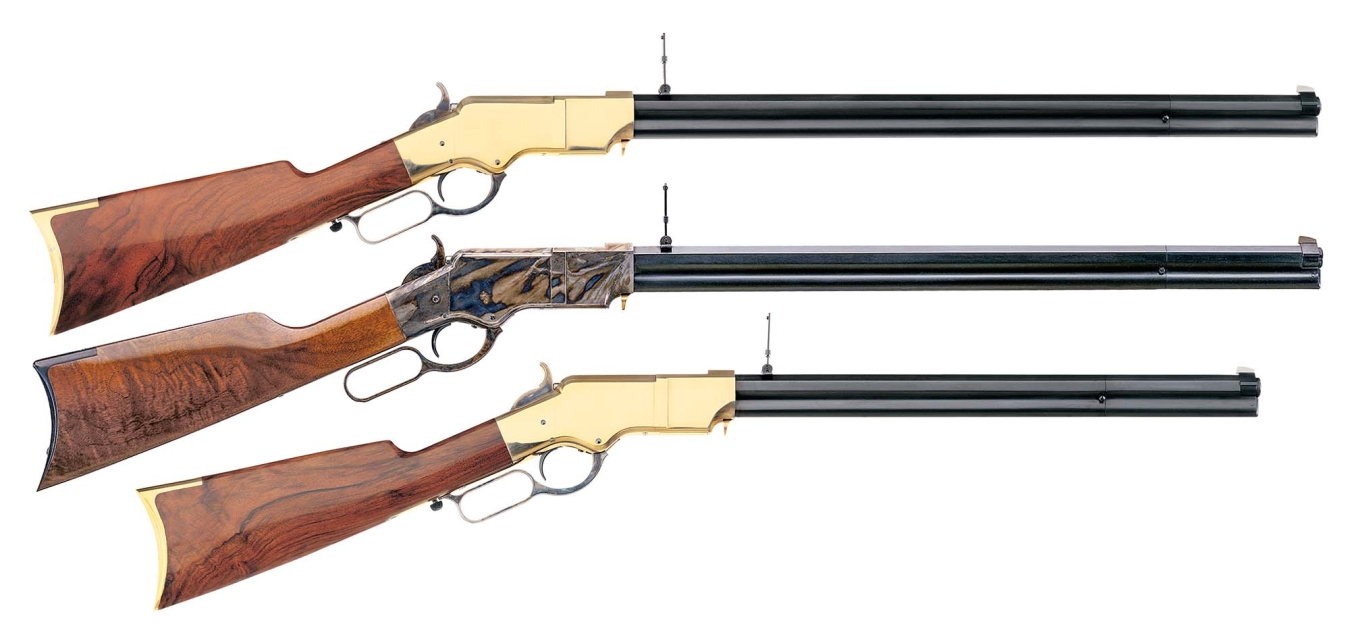
A legendary icon, the Henry rifle introduced reliable repeating firepower in a world still dominated by single shot rifles. It marked an important turning point in the mid-nineteenth-century gun industry and defined the fundamental design for all American lever-action firearms.
Patented in 1860, the Henry lever-action rifle represents a pivotal shift in nineteenth-century firearms technology, designed by from Benjamin Tyler Henry’s as a refinement of earlier Volcanic designs. It was introduced to provide a reliable solution for rapid, repeatable firepower. Production spanned from 1860 to 1866, during which approximately 14,000 units were manufactured before the design evolved into the famous Winchester Model 1866.
The Henry is distinguished by its unique toggle-link lever action that allowed for a high rate of fire compared to contemporary single-shot weapons. Its standard design featured a 24-inch octagonal barrel and a tubular magazine capable of holding fifteen rounds, plus one in the chamber. The Henry lacked a wooden forend, and the magazine was loaded from the front, by manually sliding the external follower spring inside a sleeve placed in the muzzle section of the barrel. The Henry was originally chambered for the “dedicated” .44 Henry rimfire cartridge: current Uberti replicas are chambered in popular calibers like .45 Colt or .44-40.
The Henry rifle became a formidable tool during the American Civil War. Although never officially adopted for military use, many Union soldiers purchased them privately. It saw significant action at the Battle of Franklin and the Battle of Allatoona Pass, where it gave smaller units a massive tactical advantage over Confederate forces.
After the Civil War the Henry moved West, in the hands of the many settlers that conquered the American Frontier, much appreciated for its reliability and the sheer volume of fire it provided in the unpredictable American West.
Its main advantage was speed, but in military use its design showed two main drawbacks: the magazine’s open slit allowed dirt into the action, and the lack of a wooden handguard meant the barrel became painfully hot during rapid fire. But these flaws were exactly what determined the evolution of the Henry design in the next to come Winchester 1866 rifle, changing fundamentally and forever the expectations for modern rifles.
Variants
- A01 - Old West (Antique Patina Finish)
- C01 - Charcoal Blue finish
- N02 - Nickel Plating
- W01 - White finish
- AS2 - Sling swivels
- G11 - Superior Oil Finish (Henry)
- G12 - Superior Oil Finish Stock & Forend
- M02 - US Military markings
- E16 - Standard hand engraving
- E17 - Standard hand engraving (Henry Steel)
- E18 - Lincoln hand engraving
- E26 - Hand engraved Monograms
- E27 - Hand engraved single letters
- E28 - Hand engraved gold inlayed letters
- L05 - Standard laser engraving
A legendary icon, the Henry rifle introduced reliable repeating firepower in a world still dominated by single shot rifles. It marked an important turning point in the mid-nineteenth-century gun industry and defined the fundamental design for all American lever-action firearms.