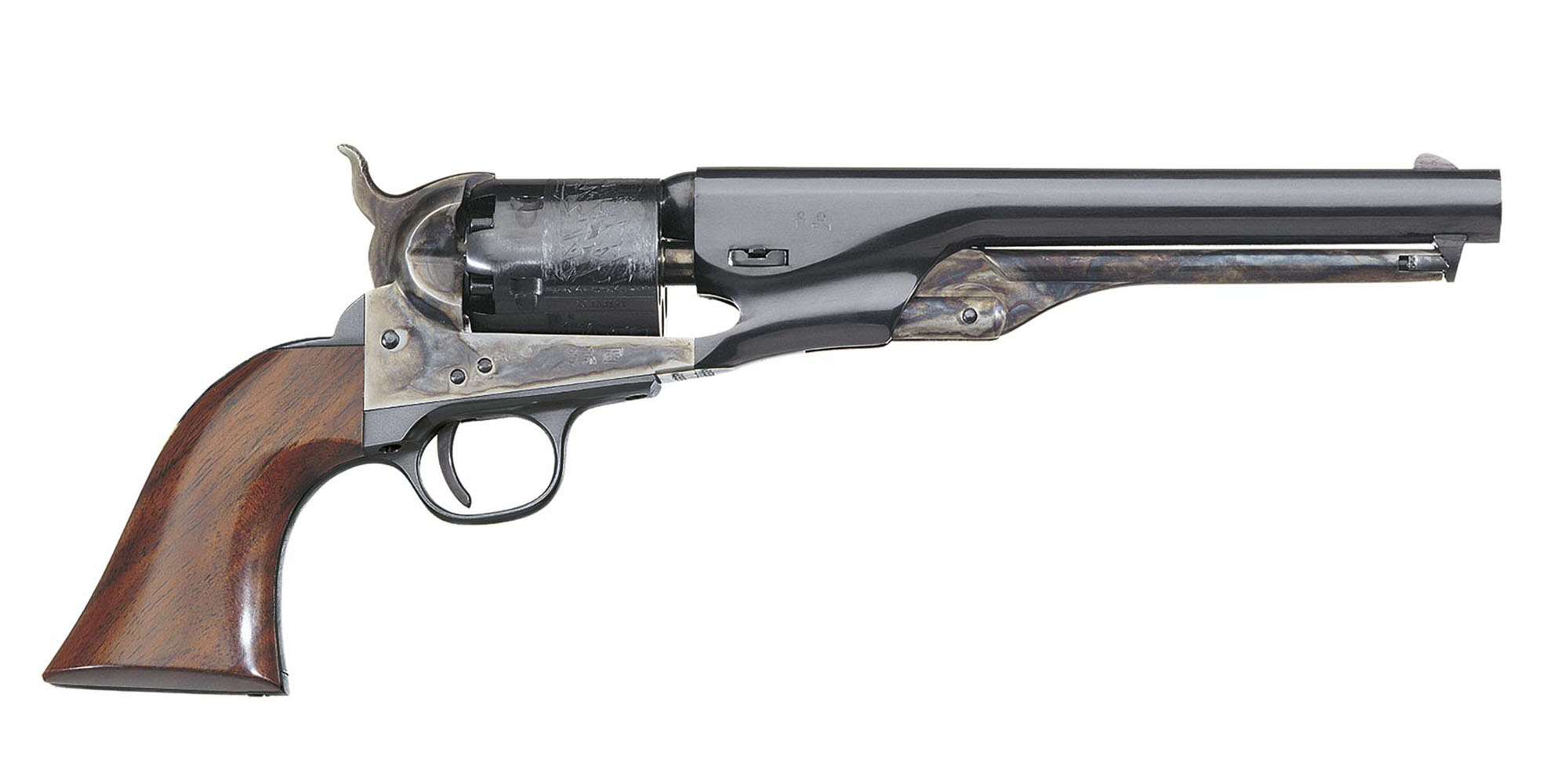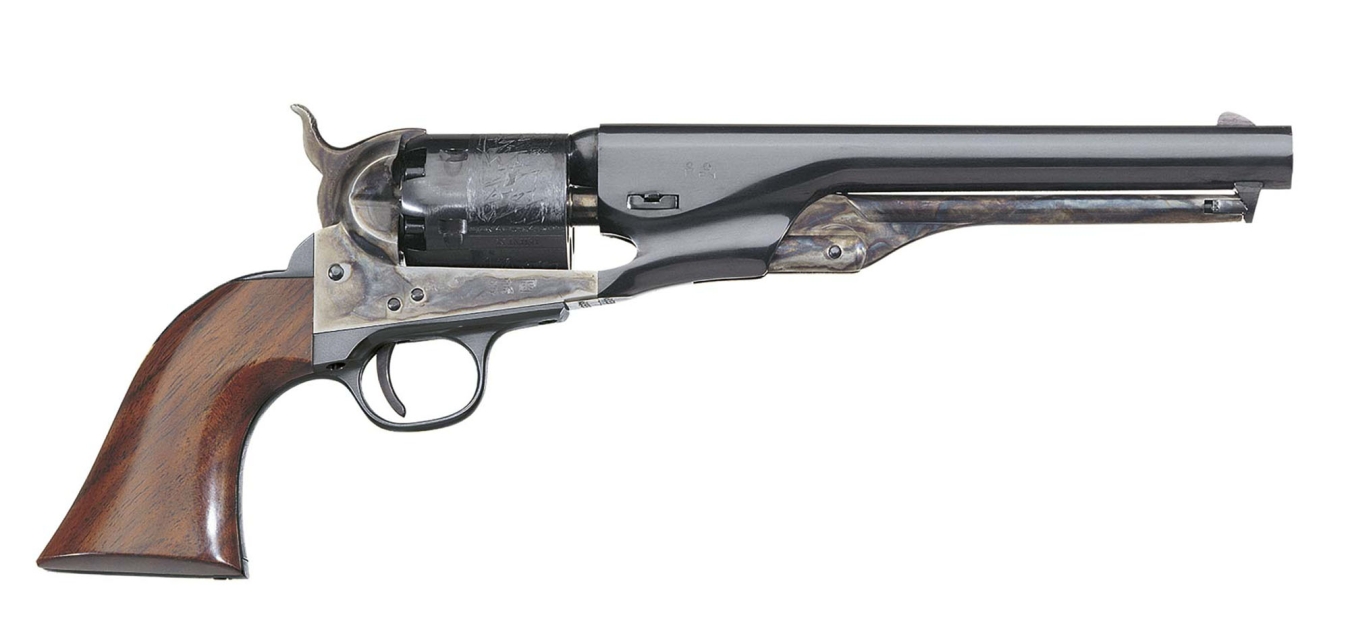
The Colt 1861 Navy revolver refined the .36 caliber sidearm adopting the streamlined design of the 1860 Army model. Though produced in smaller numbers than the 1851 Navy model, its saw significant action throughout the American Civil War.
The Colt Model 1861 Navy arrived as a sophisticated evolution of the legendary 1851 Navy, designed to modernize the .36 caliber sidearm with the streamlined aesthetics of the larger 1860 Army. Introduced in 1861 to provide a more ergonomic and balanced pistol for naval and cavalry use, its production spanned until 1873. Despite its technical refinements, it saw a relatively limited production run of approximately 38,000 units, largely because the onset of the American Civil War forced the Colt factory to prioritize the high-volume manufacturing of the .44 caliber Army model.
Mechanically, the 1861 Navy is a single-action percussion revolver chambered in .36 caliber, featuring a six-shot cylinder and a 7.5-inch round barrel. The most significant departure from its predecessor was the replacement of the old pivoting loading lever with a "creeping" rack-and-pinion system, which allowed for a much smoother and more powerful seating of the lead ball into the chamber. This model retained the classic Colt open-top frame, which lacked a top strap, contributing to its light weight and distinctive "pointability" that made it feel like an extension of the shooter’s hand.
During the American Civil War, the 1861 Navy saw service in both the Union and Confederate forces, appearing in major campaigns such as the Battle of Gettysburg and various naval skirmishes. While it was highly prized by officers for its elegance and reduced recoil compared to the .44 caliber models, it also found a place in civil contexts after the war. Explorers and lawmen in the American West appreciated its balance and the fact that its .36 caliber ammunition was lighter to carry on long journeys than heavier military loads.
The primary advantage of the 1861 Navy was its unparalleled ergonomics and the improved reliability of the geared loading lever. However, its main disadvantage remained the inherent weakness of the open-top frame, which could loosen over years of heavy use. Additionally, the .36 caliber round lacked the devastating stopping power of the .44, which led many frontline soldiers to prefer the more rugged Remington or the larger Colt Army whenever they were available.
Variants
- W00 - White finish
- C00 - Charcoal Blue finish
- N00 - Nickel finish
- A00 - Old West antique finish
- G08 - Hand rubbed oil finish on selected wood
- G13 - Polymer Ivory Grip
- G16 - Polymer Pearl Grip
- E02 - Standard hand engraving
- E04 - Tiffany hand engraving
- E05 - Prestige-gold hand engraving
- E26 - Hand engraved Monograms
- E27 - Hand engraved single letters
- E28 - Hand engraved gold inlayed letters
- L09 - Standard laser engraving
- L14 - Custer laser engraving
- L15 - Buffalo Bill laser engraving
The Colt 1861 Navy revolver refined the .36 caliber sidearm adopting the streamlined design of the 1860 Army model. Though produced in smaller numbers than the 1851 Navy model, its saw significant action throughout the American Civil War.